Loading...
Loading...
Loading...
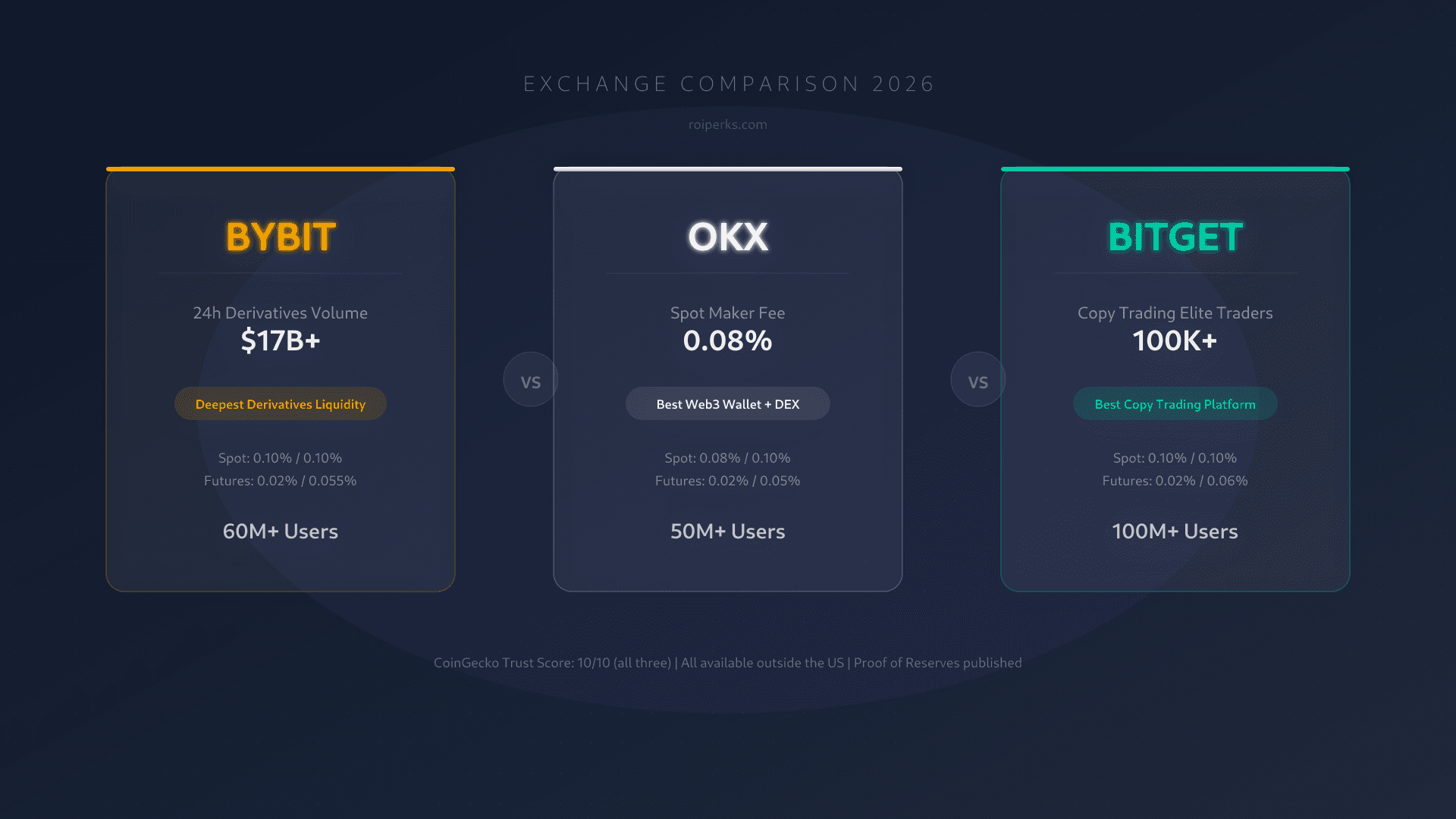
Hands-on comparison of Bybit, OKX, and Bitget in 2026 covering fees, derivatives depth, copy trading, Web3 wallets, security records, and which exchange fits spot traders, futures traders, and beginners.
If you trade crypto outside the United States, your realistic exchange options have consolidated down to a handful of serious platforms. Binance still leads on raw volume but carries regulatory baggage that makes it unavailable or restricted in growing numbers of jurisdictions. That leaves Bybit, OKX, and Bitget as the three exchanges most non-US traders are actually choosing between in 2026.
We have traded on all three for months: spot, futures, earn products, copy trading, Web3 wallets. None of them is the clear overall winner. Each one leads in a specific dimension and trails in others. The right choice depends on how you trade.
The quick verdict:
Sign up through our links to support our testing: Bybit | OKX | Bitget
| Feature | Bybit | OKX | Bitget |
|---|---|---|---|
| Founded | 2018 | 2017 | 2018 |
| Registered users | 60M+ | 50M+ | 100M+ (claimed) |
| Spot pairs | 800+ | 600+ | 800+ |
| Spot fees (base tier) | 0.10% / 0.10% | 0.08% / 0.10% | 0.10% / 0.10% |
| Futures fees (base tier) | 0.02% / 0.055% | 0.02% / 0.05% | 0.02% / 0.06% |
| 24h derivatives volume | ~$17B | ~$10B | ~$8B |
| Copy trading | Growing | Basic | Industry-leading |
| Web3 wallet | Built-in | Built-in (best-in-class) | Bitget Wallet (standalone) |
| Native token | None | OKB | BGB |
| Proof of reserves | Yes | Yes | Yes (300%+ ratio claimed) |
| Earn products | Savings, launchpool | Savings, staking, on-chain earn | Savings, staking |
| P2P fiat trading | Yes | Yes | Yes |
| Major security incident | Feb 2025 ($1.46B, all users covered) | None | None |
| CoinGecko Trust Score | 10/10 | 10/10 | 10/10 |
| US access | No | No | No |
The user counts deserve a note: Bitget's 100M+ figure comes from their own press releases and has not been independently verified to the same degree as Bybit's or OKX's numbers. Take it as a marketing claim rather than an audited figure.
Fee schedules on exchange websites are designed to look competitive. The real question is what you pay in practice, and that depends on your volume tier, whether you use limit or market orders, and which trading pairs you touch.
Spot trading at base tier: OKX charges 0.08% maker and 0.10% taker, making it the cheapest of the three for anyone starting out. Bybit and Bitget both charge 0.10% flat for makers and takers. The difference is small in absolute terms (on a $1,000 trade, you save $0.20 per side on OKX versus the other two), but it compounds for active traders. At VIP tiers (roughly $10M+ monthly volume), all three converge to similar rates in the 0.02-0.04% range, so the base-tier advantage matters most for small to mid-size traders.
Futures trading is where the three are closest. Bybit charges 0.02% maker and 0.055% taker. OKX is 0.02% maker and 0.05% taker. Bitget sits at 0.02% maker and 0.06% taker. On leveraged positions the taker fee difference between OKX (cheapest) and Bitget (most expensive) adds up to $1 per $10,000 in notional value. That is meaningful if you trade large size daily, but negligible for occasional positions.
What we actually tested: We ran the same $500 USDT-to-BTC spot market order on all three within the same two-minute window. OKX filled at the tightest effective spread (mid-market to execution price), Bybit was a fraction behind, Bitget slightly wider. On limit orders the difference was negligible; all three filled at the posted price with no issues. We also compared USDT (TRC-20) withdrawal fees: Bybit charged 1 USDT, OKX charged 0.8 USDT, and Bitget charged 1 USDT. Small numbers, but they add up if you withdraw frequently.
Hidden costs to watch: All three offer a "Convert" feature for quick swaps without an order book. The convenience comes with wider spreads (typically 0.3-0.5%) that you would not pay using the spot trading interface. Funding rates on perpetual futures vary by platform and position demand; check these before holding leveraged positions overnight.
This is where Bybit separates from the pack. As of early 2026, Bybit's 24-hour derivatives volume regularly exceeds $17 billion, putting it second only to Binance globally. OKX runs roughly $10 billion and Bitget around $8 billion on active days.
Volume translates directly to liquidity, which translates directly to execution quality. On Bybit's BTC-USDT perpetual contract, we placed market orders up to $25,000 in notional value and saw less than 0.01% slippage from the displayed price. OKX was comparable on BTC and ETH pairs but showed slightly wider fills on altcoin perpetuals. Bitget's top-20 pairs offered acceptable depth, but on lower-cap perpetuals we occasionally saw wider spreads than the other two.
Leverage: All three offer up to 125x on BTC perpetuals (reduced on altcoins). We would not recommend anyone use anything close to that; it exists for marketing purposes more than practical trading. Still, the availability signals matching engine capacity.
Options trading: OKX stands out here. It operates one of the most liquid crypto options markets outside Deribit, with structured products (Simple Options for beginners, full chain for advanced strategies). Bybit offers options but with less depth. Bitget's options offering is minimal.
If derivatives are your primary activity, Bybit is the default. If you want options exposure alongside futures, OKX is the better choice.
Bitget built its reputation on copy trading and it shows. The platform lists over 100,000 "elite traders" whose portfolios you can automatically mirror. Each trader has a public profile with ROI, maximum drawdown, win rate, trading frequency, and follower count. You can filter by asset class, risk level, and time period. The filtering is granular enough to be genuinely useful rather than decorative.
We followed three traders on Bitget for five weeks during testing. The interface for setting allocation limits, stop-loss thresholds, and position sizing per copied trader is well designed. Execution was reliable: copies triggered within seconds of the lead trader's action, with minimal deviation on entry price. The transparency around each trader's historical performance is the best we have seen on any exchange.
Bybit's copy trading has improved significantly through 2025 but the roster of top traders is thinner. The interface works but feels like a feature bolted onto a derivatives platform rather than a core product. We followed two traders on Bybit over the same period. Execution was fine, but we had fewer quality traders to choose from after filtering for consistent performance.
OKX has copy trading but does not position it as a flagship feature. The selection is smaller and the filtering tools are less developed than Bitget's.
Bottom line on copy trading: If copying experienced traders is a significant part of your strategy, Bitget is the clear choice. If it is a secondary feature you might use occasionally, Bybit or OKX will do.
OKX wins this category decisively. The OKX Web3 Wallet supports over 80 blockchains, integrates a DEX aggregator that routes swaps through the best available on-chain liquidity, and lets you trade on-chain tokens directly from your exchange account without bridging or external wallet software. It is widely regarded as the best CEX-integrated Web3 wallet in the industry, and our experience confirms that.
During testing, we swapped tokens on Arbitrum and Base through OKX's DEX aggregator and consistently got better execution than going directly through Uniswap's interface, because OKX routes across multiple DEXs simultaneously. The wallet supports NFTs, DeFi positions, and cross-chain bridges in a single interface. For anyone who moves between centralized and decentralized trading, OKX makes the transition seamless.
Bybit's built-in Web3 wallet covers the basics (multi-chain support, token swaps, DApp browser) but supports fewer chains and the DEX aggregation is less sophisticated. Functional, not exceptional.
Bitget Wallet (formerly BitKeep) is a separate standalone app with over 100 million claimed downloads. It supports multiple chains and has its own swap feature. The separation from the main Bitget exchange app means the experience is less unified; you are effectively using two products rather than one integrated platform.
This is the section that matters most and where honest assessment costs nothing.
Bybit, February 2025: Attackers linked to North Korea's Lazarus Group compromised Bybit's Ethereum cold wallet and drained approximately $1.46 billion in assets. It was the largest single hack in crypto exchange history. Bybit's response was aggressive: they covered all user losses in full, secured bridge loans and treasury funds to maintain operations, and processed withdrawals without pause. No user lost money. Within weeks, Bybit announced a complete overhaul of its cold storage infrastructure, additional multi-signature requirements, and third-party security audits.
The hack is a legitimate mark against Bybit's security record. It happened, it was massive, and no amount of good response changes the fact that their cold wallet security failed. That said, the response itself (covering $1.46 billion without socializing losses or halting withdrawals) demonstrated financial reserves and operational discipline that most exchanges could not replicate. Whether the hack makes Bybit less trustworthy or the response makes it more trustworthy is a judgment call each trader has to make.
OKX has no major hack or exploit on its record. There have been isolated incidents of individual users being phished or socially engineered, which is not a platform-level failure. OKX publishes monthly proof-of-reserves reports and holds regulatory licenses in multiple jurisdictions including Dubai, the EU (MiCA), and Singapore.
Bitget also has a clean security record with no major platform-level breach. They publish proof of reserves claiming a 300%+ reserve ratio, meaning they hold more than three times the value of user deposits in verifiable reserves. Bitget also maintains a $300 million+ protection fund earmarked for user compensation in case of a security event.
All three support two-factor authentication, withdrawal address whitelisting, anti-phishing codes, and device management. These are table stakes. The differentiator is incident history and financial backing to handle worst-case scenarios.
Our view: if you are splitting funds across exchanges rather than concentrating everything in one place (which is a reasonable risk management practice regardless), Bybit's derivatives liquidity still justifies using it for that purpose while keeping longer-term holdings on OKX or Bitget.
All three offer savings products (flexible and fixed-term), staking for PoS assets, and launchpool or launchpad events for new token farming. The yields fluctuate and are not dramatically different across platforms. Stablecoin flexible savings hover around 2-5% APR on all three, with promotional rates occasionally higher.
Where they differ:
Bybit Launchpool is one of the most popular new-token farming mechanisms. Stake BTC, ETH, or USDT to earn allocations of newly listed tokens. The returns are variable but Bybit's track record of listing quality projects makes their launchpool events consistently oversubscribed.
OKX offers on-chain earn products through its Web3 wallet. You can deposit into DeFi protocols like Aave or Lido directly from the OKX interface, earning on-chain yields without managing separate wallet software. This is a meaningful differentiator for anyone who wants DeFi exposure without the operational overhead.
Bitget earn products are straightforward: savings, staking, and occasional promotions. Nothing uniquely differentiated, but functional and easy to use.
None of these earn products should be mistaken for risk-free savings. Exchange-offered yields involve counterparty risk (the exchange holding your funds), smart contract risk (for on-chain products), and market risk (for non-stablecoin deposits).
All three operate P2P marketplaces where you can buy and sell crypto directly with other users using local payment methods. This is particularly relevant for traders in countries without direct fiat deposit rails, Serbia included.
In our experience, OKX's P2P marketplace had the most active order book for EUR and local Balkan payment methods. Bybit's P2P was close behind with good SEPA coverage. Bitget's P2P works but with fewer market makers in our region, which sometimes meant wider spreads between buy and sell prices.
If fiat on-ramping through P2P is important to you, check the available payment methods and active order depth in your specific currency before committing to a platform.
The choice comes down to what you actually do on an exchange. If derivatives are your primary activity (perpetual futures, leveraged positions, high-frequency entries and exits), Bybit's order book depth is hard to beat. The February 2025 hack is a factor, but the response was handled better than any previous exchange breach in crypto history. For a derivatives-focused trader who keeps most capital elsewhere and moves trading funds to Bybit for execution, the liquidity advantage is tangible.
OKX is the most complete platform of the three. Lowest base spot fees, a competitive derivatives exchange, the best Web3 wallet in the CEX category, options trading, and on-chain DeFi integration. If you want a single exchange that handles everything from spot trading to on-chain yield farming without switching between apps, OKX is it. The trade-off is that none of its individual features are the absolute best. It is the best-rounded, not the best at any single thing.
Bitget has found its niche in copy trading and leaned into it intelligently. If you are newer to active trading, or if you prefer to allocate a portion of your portfolio to follow experienced traders while learning, Bitget's infrastructure for that is meaningfully better than the competition. The exchange's BGB token has also been one of the stronger-performing exchange tokens, which matters if you are considering fee discounts through token holding.
For traders in Serbia and the broader Balkans: all three work, all three have P2P options for local payment methods, and none have geographic restrictions for the region. We have used all three from Serbia without issues.
| If you... | Use... | Because... |
|---|---|---|
| Trade futures primarily | Bybit | Deepest derivatives liquidity outside Binance |
| Want the lowest spot fees | OKX | 0.08% maker at base tier |
| Want one app for CEX + DeFi | OKX | Best Web3 wallet and DEX integration |
| Want to copy experienced traders | Bitget | Largest and most transparent copy trading platform |
| Prioritize clean security record | OKX or Bitget | No major platform-level breach |
| Want options trading | OKX | Most liquid crypto options outside Deribit |
| Want new token farming | Bybit | Strongest launchpool track record |
There is no single winner. There is only the exchange that fits what you actually need. If you are unsure, OKX is the safest all-around choice: competitive on every dimension, best-in-class on none, and no security baggage. If you know exactly what you need, Bybit or Bitget may serve that specific need better.
Ready to try them? Sign up through our links to support our testing: Bybit | OKX | Bitget
Disclosure: This article contains affiliate links. If you sign up through our links, we may earn a commission at no extra cost to you. This does not influence our rankings or assessments. We tested all three platforms with our own funds. Features, fees, and availability can change. This is not financial advice.
Ranked and tested: the seven best crypto exchanges for traders outside the United States in 2026, covering fees, features, security, and real-world availability.
Hands-on review of Krak — the crypto-powered global money app — with instant cross-border transfers, multi-currency wallets, rewards, and referral tips.
A risk-tiered comparison of stablecoin yield options in 2026. CEX savings, Krak Vaults, Aave, Morpho, Pendle, and more, ranked by risk and return.