Loading...
Loading...
Loading...
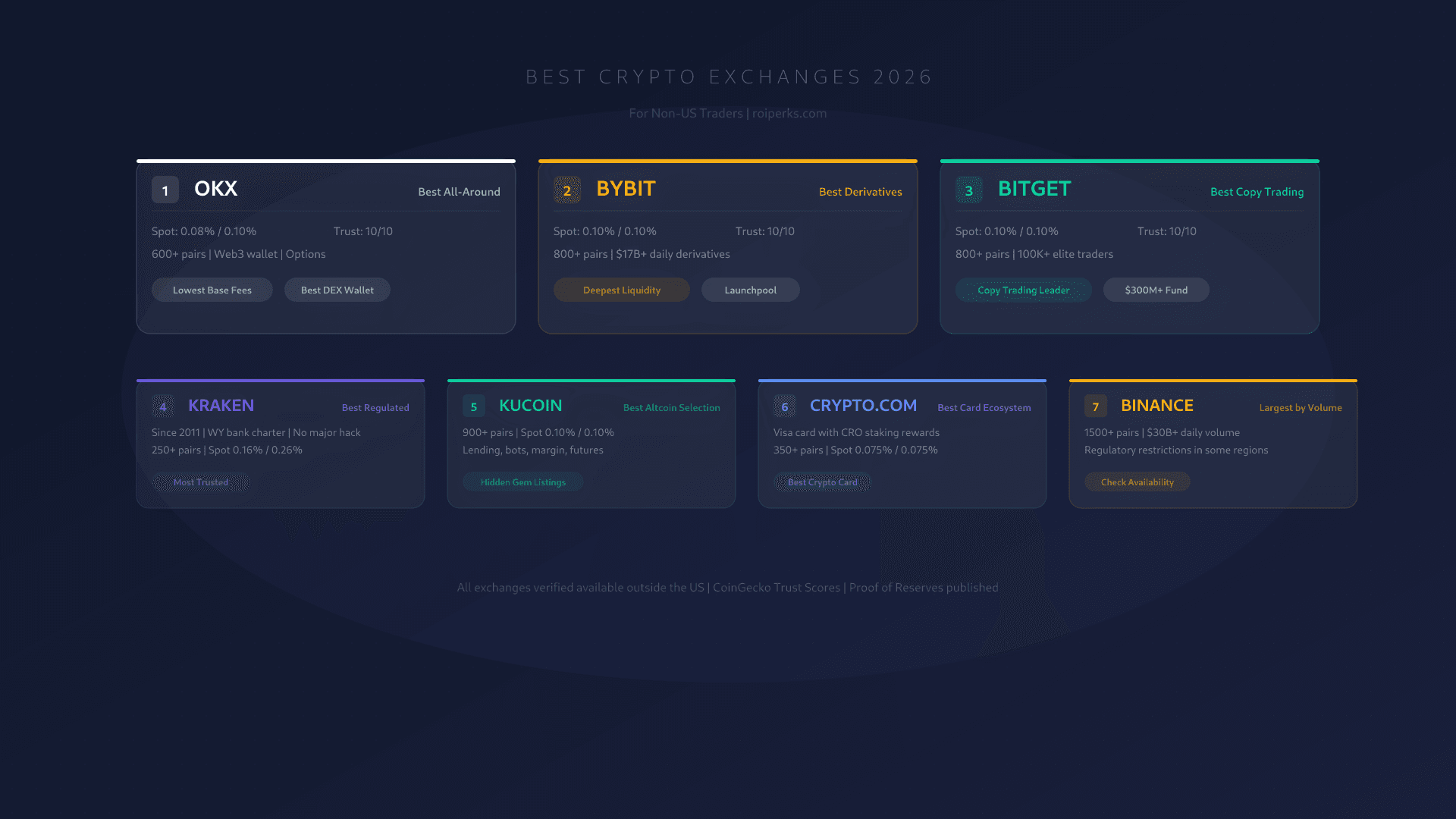
Hands-on ranking of seven crypto exchanges for non-US traders in 2026. Each platform tested on fees, derivatives, security, Web3 features, and ease of use.
US-based crypto traders pick from a short list: Coinbase, Kraken, maybe Gemini, and whatever else survives the SEC's evolving enforcement posture. The rest of the world gets a much wider menu. More exchanges, more features, fewer artificial restrictions.
The tradeoff is noise. Dozens of exchanges claim to serve international users, and the quality gap between the best and the worst is enormous. Some are legitimate trading platforms with deep liquidity and strong security practices. Others are thinly regulated operations running on marketing spend and inflated volume numbers.
We created accounts on every major exchange accessible from Europe, deposited real money, and traded across spot, futures, and earn products for months. This ranking comes from that testing. Not from press releases, not from "number of listed coins" spreadsheets, and not from who pays the highest affiliate commissions.
Affiliate disclosure: referral links in this article support our testing. Rankings are based on merit. We use every exchange we recommend.
Three dimensions carried the most weight:
Trading costs in practice. Published fee schedules are a starting point. Real costs include slippage, withdrawal fees, and spread width on the pairs you actually trade. We measured all of these.
Product depth beyond spot trading. Spot is table stakes. What separates serious platforms from token casinos is the quality of derivatives, earn products, copy trading, Web3 integration, and payment features.
Trust and track record. Published proof of reserves, regulatory licenses held, hack history, and (critically) how each exchange handled its worst crisis. A platform that survived a major incident and made users whole tells you more about its financial health than any marketing page.
Availability was the filter, not a ranking factor. Every exchange on this list works in most non-US jurisdictions, but regional restrictions exist. Verify before you deposit.
OKX has quietly assembled the most complete exchange for non-US traders. Start with the fees: 0.08% maker and 0.10% taker at the base tier is the lowest of any major platform. That matters if you are an active spot trader. Over thousands of trades, 0.02% adds up faster than you might expect.
But fees alone do not earn the top spot. The Web3 wallet is what separates OKX from the pack. It aggregates decentralized exchanges across 80+ chains, handles cross-chain swaps natively, and lives inside the same app you use for centralized trading. You can move between Uniswap, PancakeSwap, and OKX's own order book without switching interfaces. No other exchange integrates CeFi and DeFi this cleanly.
Derivatives liquidity is serious. OKX supports perpetual and quarterly futures, options, and spread positions across hundreds of pairs. The BTC and ETH perpetual order books consistently rank in the global top three for depth. Slippage on a $50,000 market order is minimal.
The platform's one real weakness is community presence. OKX does not run the same relentless promotional machine that Bybit or Binance does. Fewer trading competitions, fewer influencer partnerships, less noise. Whether that is a negative depends on what you value.
Bybit was built for derivatives traders, and that foundation still shows. BTC perpetual liquidity on Bybit is the deepest outside Binance. If you trade futures with any real position size, order book depth matters more than a 0.02% spot fee difference, and Bybit wins here convincingly.
The exchange cannot be discussed in 2026 without addressing February 2025. A $1.46 billion hack, attributed to North Korea's Lazarus Group, made it the largest exchange theft in crypto history. Bybit covered every affected user in full. No socialized losses, no "we'll pay you back eventually" promises. The exchange had the reserves to absorb the hit and resume operations within days. Its cold storage architecture was rebuilt from the ground up afterward.
Whether that makes Bybit more or less trustworthy is a legitimate debate. We lean toward viewing it as a stress test the exchange passed, but we understand those who see it differently.
Beyond derivatives, Bybit has expanded meaningfully. Spot pairs number over 700, the earn product suite covers fixed and flexible options, and copy trading is growing (though it trails Bitget's). The Bybit Card launched in select regions, adding a spending layer. The interface is fast and clean.
For a detailed breakdown of how Bybit compares to OKX and Bitget on specific features, see our three-way comparison.
Bitget is the copy trading exchange. Over 100,000 elite traders are available to follow, each with transparent P&L histories, drawdown metrics, risk scores, and configurable allocation limits. If you want exposure to crypto derivatives without managing every position yourself, this is where you start. The infrastructure is years ahead of what Bybit or OKX offer in this category.
The exchange has grown fast beyond copy trading too. Spot and futures selection is broad (800+ tokens), base fees match Bybit at 0.10%/0.10%, and the product suite now includes grid bots, strategy trading, and an in-app Web3 wallet. Bitget's protection fund exceeds $300 million, and monthly proof-of-reserves reports are published on schedule.
Where Bitget falls short: derivatives liquidity on major pairs is thinner than Bybit or OKX. If you are moving large size on BTC or ETH perpetuals, you will notice wider spreads. On mid-cap and altcoin futures, the gap narrows considerably.
The interface leans beginner-friendly. Navigation is straightforward, onboarding is guided, and the learning curve is gentle. Power users may find fewer advanced order types and less charting flexibility compared to OKX. For its target audience, that tradeoff works.
Kraken does not chase trends. Founded in 2011, it holds more regulatory licenses than any other exchange on this list: a Wyoming SPDI bank charter (the first ever granted to a crypto company), MiFID registration in Europe, and FCA authorization in the UK. If regulatory compliance is your primary concern, the decision is easy.
Fees are the weak spot. Kraken Pro starts at 0.16% maker and 0.26% taker for monthly volume under $50,000. That is noticeably more expensive than the top three. Higher volume tiers improve significantly (dropping below 0.10% maker at $10M+), but casual or moderate traders will feel the cost difference on every trade.
The derivative offering has expanded in recent years but still covers fewer pairs than Bybit, OKX, or Bitget. Staking is available on a solid range of assets with competitive yields. Spot selection runs over 300 pairs.
The more interesting Kraken story for 2026 is the Krak app: a consumer payments product with instant P2P transfers via Kraktag handles, multi-currency wallets spanning fiat and crypto, a Mastercard debit card with up to 1% cashback, and yield-bearing Vaults. It represents Kraken's push beyond trading into everyday personal finance, and the execution so far is strong.
Kraken is not the cheapest or the most feature-rich exchange. It is the one with the longest track record and the strongest compliance posture, and for a certain type of user, that matters more than anything else.
KuCoin lists tokens faster than almost any major platform. When a project starts generating attention on Crypto Twitter but has not appeared on Bybit or OKX yet, KuCoin probably has it. For altcoin discovery and early-stage token access, this exchange is hard to beat.
The speed comes with history worth noting. KuCoin lost $281 million in a September 2020 hack (the majority was eventually recovered through on-chain tracing and project cooperation). In 2024, the exchange faced US DOJ charges resulting in a guilty plea and $297 million in fines related to operating without proper money transmission licensing. KuCoin has since tightened KYC requirements globally.
Day-to-day trading is solid. Fees sit at 0.10%/0.10% base. The trading bot marketplace is one of the more developed in the industry, offering grid, DCA, infinity grid, and futures bot templates with configurable parameters. Earn products and margin trading round out the feature set. Over 900 tokens are listed.
We rank KuCoin fifth rather than higher because the regulatory and security history introduces a layer of uncertainty the top four do not carry. For altcoin-focused traders who understand and accept that risk, it fills a real niche.
Crypto.com spent hundreds of millions on naming rights (the Staples Center, Formula 1 sponsorships, UFC partnerships) and the brand recognition worked. The product behind the marketing is decent, though not exceptional by 2026 standards.
The Visa card program was the original draw. Stake CRO tokens, receive cashback on purchases at rates from 1% to 5% depending on your staking tier. Multiple rounds of benefit cuts since 2022 have reduced the card's appeal considerably, but even at reduced rates, it remains the most developed crypto-linked card ecosystem in the industry. Lounge access, Spotify rebates, and other perks persist at higher tiers.
Published spot fees are 0.075% maker and 0.075% taker, which looks excellent on paper. In practice, liquidity on non-major pairs is thin enough that slippage can erase the fee advantage. On BTC/USDT or ETH/USDT, execution is fine. On a mid-cap altcoin pair, expect wider real costs.
Where Crypto.com works best: as a fiat on-ramp and daily spending tool. Deposits are smooth across many countries, the mobile app is polished for beginners, and the card adds utility that pure-trading exchanges do not offer. If you treat it as a spending and savings platform rather than a primary trading venue, the value proposition holds up.
Binance is still the largest exchange by trading volume, and for pure liquidity on major pairs, nothing touches it. The BTC/USDT spread is the tightest in the industry. Derivatives order book depth is in a class of its own. If your only criterion were execution quality, this would be number one.
It is seventh because availability is the entire premise of this list, and Binance's availability is shrinking. The exchange has exited or been restricted in the Netherlands, Belgium, and Germany. UK users lost access to derivatives in 2021. Regulatory pressure across the EU continues under MiCA. The 2023 US DOJ settlement and $4.3 billion fine, while primarily a US matter, has rippled into how European regulators view the platform.
If Binance is fully functional in your jurisdiction today, it is a strong trading platform. Base fees of 0.10%/0.10% (with BNB discounts available), the broadest product suite in crypto, a launchpad with genuine deal flow, and Binance Academy as arguably the best free crypto education resource available. The exchange earned its market position for real reasons.
The ranking reflects a practical reality for most non-US readers: access you have today may be restricted tomorrow. Building your entire trading workflow on a single platform that faces active regulatory proceedings in multiple jurisdictions is a risk. The top three on this list do not carry that same uncertainty.
| Exchange | Base Spot Fee (Maker/Taker) | Futures | Coins | Proof of Reserves | Standout Feature |
|---|---|---|---|---|---|
| OKX | 0.08% / 0.10% | Yes | 700+ | Yes | Web3 wallet + DEX aggregator |
| Bybit | 0.10% / 0.10% | Yes | 700+ | Yes | Deepest derivatives liquidity |
| Bitget | 0.10% / 0.10% | Yes | 800+ | Yes | Copy trading (100K+ traders) |
| Kraken | 0.16% / 0.26%* | Yes | 300+ | Yes | Regulatory strength + Krak app |
| KuCoin | 0.10% / 0.10% | Yes | 900+ | Yes | Fastest altcoin listings |
| Crypto.com | 0.075% / 0.075% | Yes | 350+ | Yes | Visa card ecosystem |
| Binance | 0.10% / 0.10% | Yes | 400+ | Yes | Unmatched liquidity |
*Kraken Pro entry tier. Standard buy/sell is higher.
The right exchange depends on what you actually do with it. Here is how we would allocate:
You trade futures with real size. Bybit first, OKX second. Order book depth on BTC and ETH perpetuals is what matters, and these two lead by a clear margin.
You want the lowest all-in cost for spot. OKX. The 0.08% maker fee is the lowest at any entry tier, and real-world slippage on major pairs is tight.
You are newer to trading and want to learn by following experienced traders. Bitget. Copy trading infrastructure that is years ahead of the competition.
Regulatory compliance is your top priority. Kraken. More licenses, a longer track record, and the most conservative approach to compliance.
You hunt early-stage altcoins. KuCoin. Fastest listings, largest selection, but understand the regulatory history before committing significant capital.
You want a crypto-linked card for daily spending. Crypto.com. The card program has been trimmed but still leads the industry in scope.
You need maximum liquidity and Binance is unrestricted in your jurisdiction. Binance. Nothing matches it on volume. Just have a backup plan ready.
A few names that show up on other "best of" lists but that we would not recommend based on our testing:
Gate.io lists thousands of tokens, but liquidity on most is paper-thin. Regulatory standing is unclear in many jurisdictions. The interface is cluttered and the mobile app is unreliable. Better options exist at every price point.
MEXC runs zero-fee spot promotions that look attractive until you check withdrawal costs, which are consistently above average. Customer support is slow, and the exchange has faced repeated accusations of wash trading to inflate volume numbers. Proceed with caution.
HTX (formerly Huobi) went through ownership changes and significant staff reductions in 2023 and 2024. Trading volume has declined from its peak. We would not hold meaningful funds on a platform with that level of operational uncertainty.
No single exchange is the right choice for everyone. Our top three (OKX, Bybit, Bitget) cover the large majority of use cases for non-US traders. Running accounts on two or three platforms is not overly cautious; it spreads custodial risk and lets you use each exchange where it is strongest.
Whatever you choose, treat security configuration as a requirement, not an afterthought. Hardware key for two-factor authentication, withdrawal address whitelisting, anti-phishing codes. Exchange hacks happen to platforms with billions in reserves and entire security teams. Your individual account settings are the one variable you control directly.
Our referral links: OKX | Bybit | Bitget | Kraken | KuCoin | Crypto.com | Binance
We tested all three. Here is how Bybit, OKX, and Bitget compare on fees, features, security, and what actually matters for non-US traders in 2026.
Hands-on review of Krak — the crypto-powered global money app — with instant cross-border transfers, multi-currency wallets, rewards, and referral tips.
A risk-tiered comparison of stablecoin yield options in 2026. CEX savings, Krak Vaults, Aave, Morpho, Pendle, and more, ranked by risk and return.